Company, locations and partnerships
The previous posts covered a lot of infrastructure: models, services, the data layer, realtime. This is the first post where that infrastructure becomes a screen someone actually uses.
What we built
Company Profile is a single page that brings together everything the application knows about a company: who they are, where they operate, the commercial relationships we have with them, the orders we have placed, the inventory they have supplied, and any notes the team has added.
The page comprises multiple data points: Company, Location, Partnership, and the order and inventory data from earlier posts. None of those domains was designed with this specific page in mind. They were designed as independent areas of the data model. The page composes them.
The problem it solves
A supplier record on its own only tells part of the story. Orders, locations, contacts, supplied materials and the history of the relationship all become more useful when they are connected.
A soap maker running a production operation needs all of that information connected. What have we ordered from this supplier? What did we actually receive? Which of their locations does the pickup go to? Who is the contact for this relationship? Those are not separate questions. They belong to the same commercial relationship.
The Company Profile is one answer to all of them.
How the data layer makes this possible
The previous posts described how the frontend data layer works: server responses are shredded into a normalised local store, and each domain reads from it independently. That design pays off here.
When Company Profile loads related information, those records become part of the same normalised local store used throughout the application. The partnerships section can use records that arrived with the company rather than fetching and maintaining another copy. If shared information such as the company name changes, everywhere composing that record can update from the same source.
Locations follow the same pattern. Location and address records become shared data rather than copies owned by this particular screen. Realtime changes propagate through the same frontend data layer, so the profile stays current without each section implementing its own refresh logic.
Partnerships
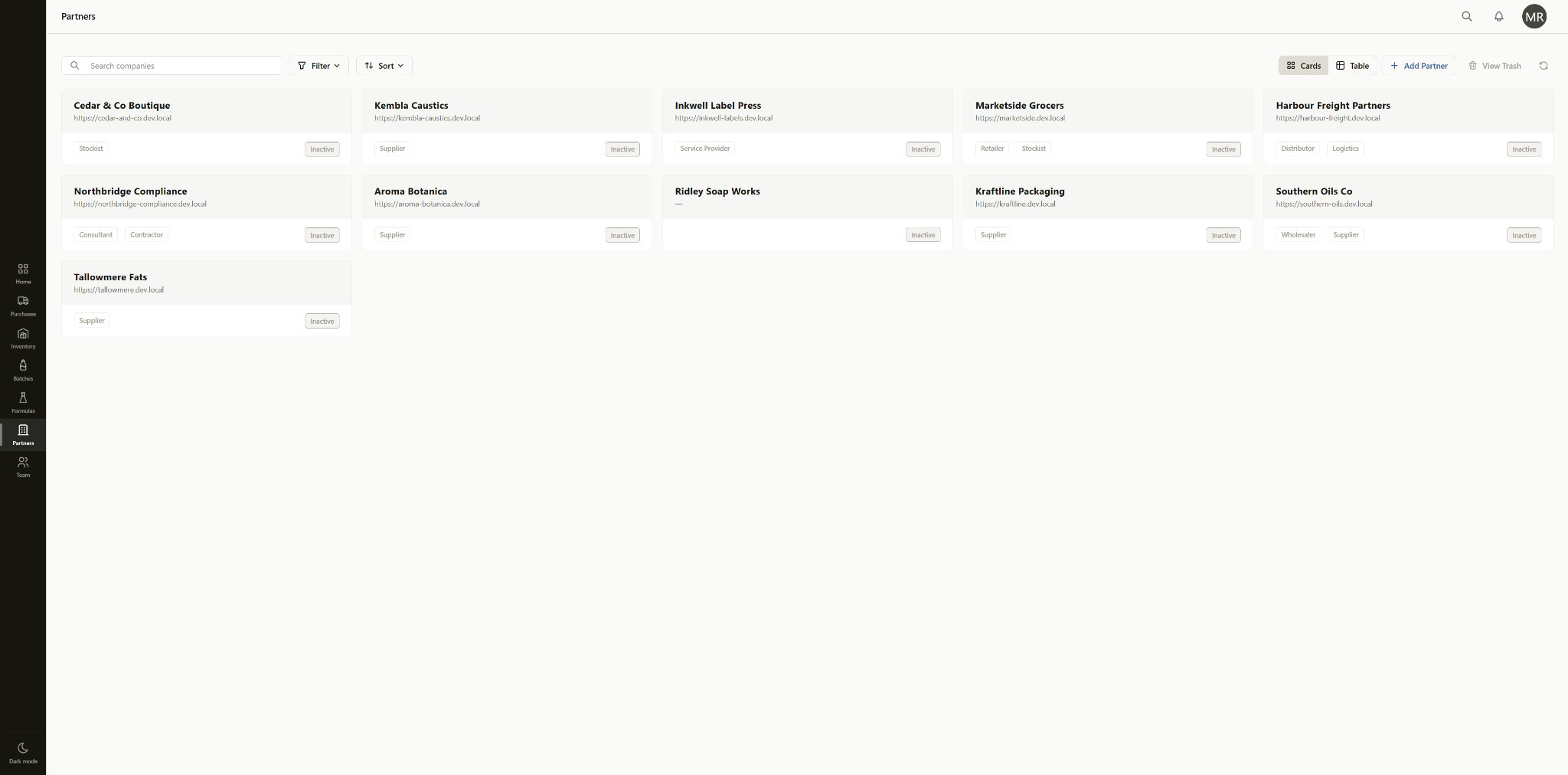
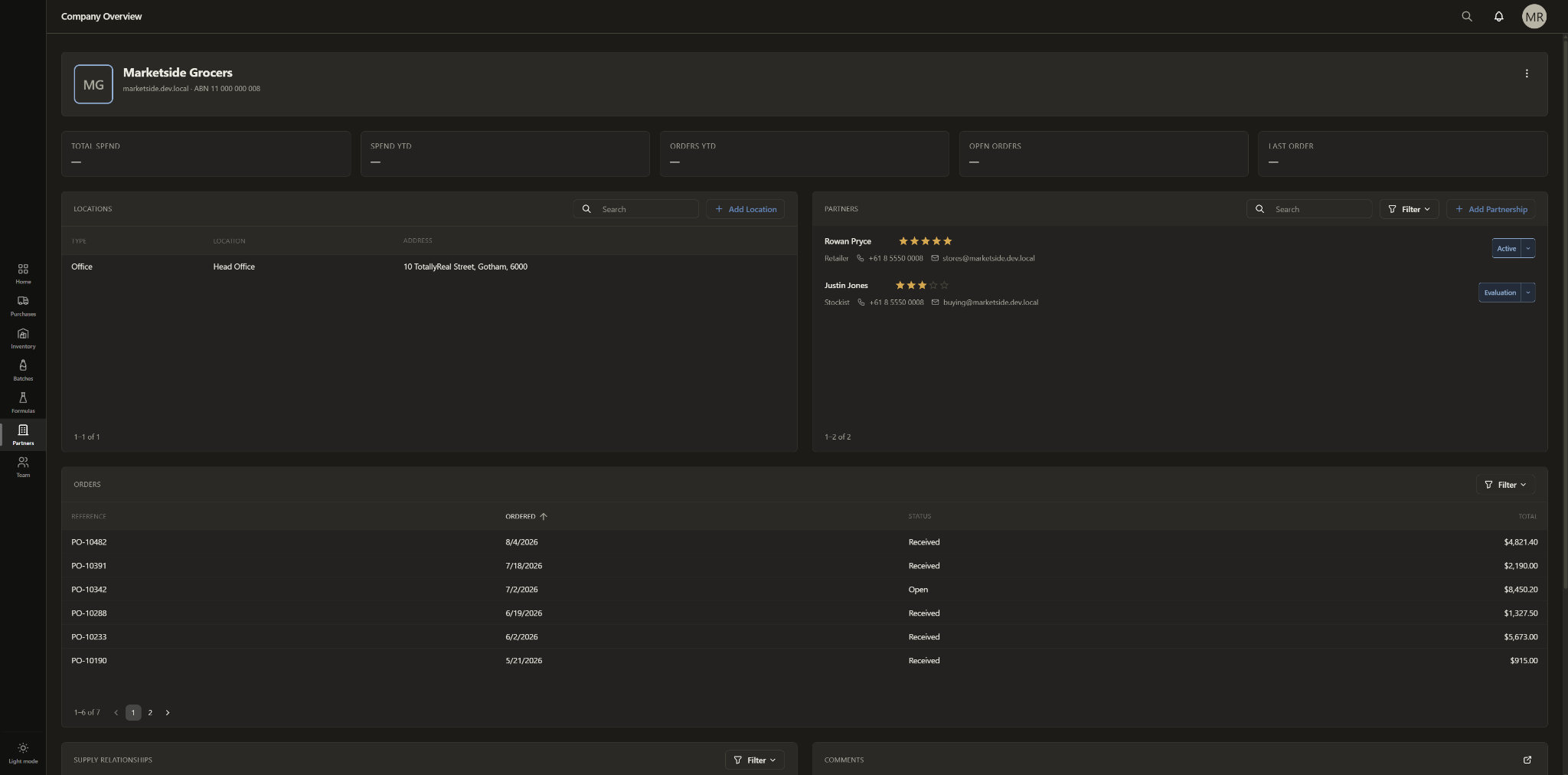
A company can have more than one partnership with us. The same company might be both a supplier and a stockist, with separate contacts, start dates and lifecycle states for each relationship. The partnerships section shows all of them as cards, searchable and filterable by type.
Each card shows the contact details for that specific relationship, the partnership type, the current lifecycle state, and the rating. Active and ended relationships sort separately. The section handles empty states, search, filtering, and paging within a fixed-height body so the rest of the profile stays stable.
Locations
Locations represent the physical places a company operates from: warehouses, manufacturing sites, offices, market stalls, pickup points. A location belongs to a company, has a type, an optional label and description, and can carry multiple addresses.
On the profile the locations sit beside the partnerships in a paired grid. Type, label and address are all searchable. Clicking a location opens it for editing. This is the same model that will eventually connect to purchase orders and inventory receipts: the stock came from this location, at this address.
The rest of the profile
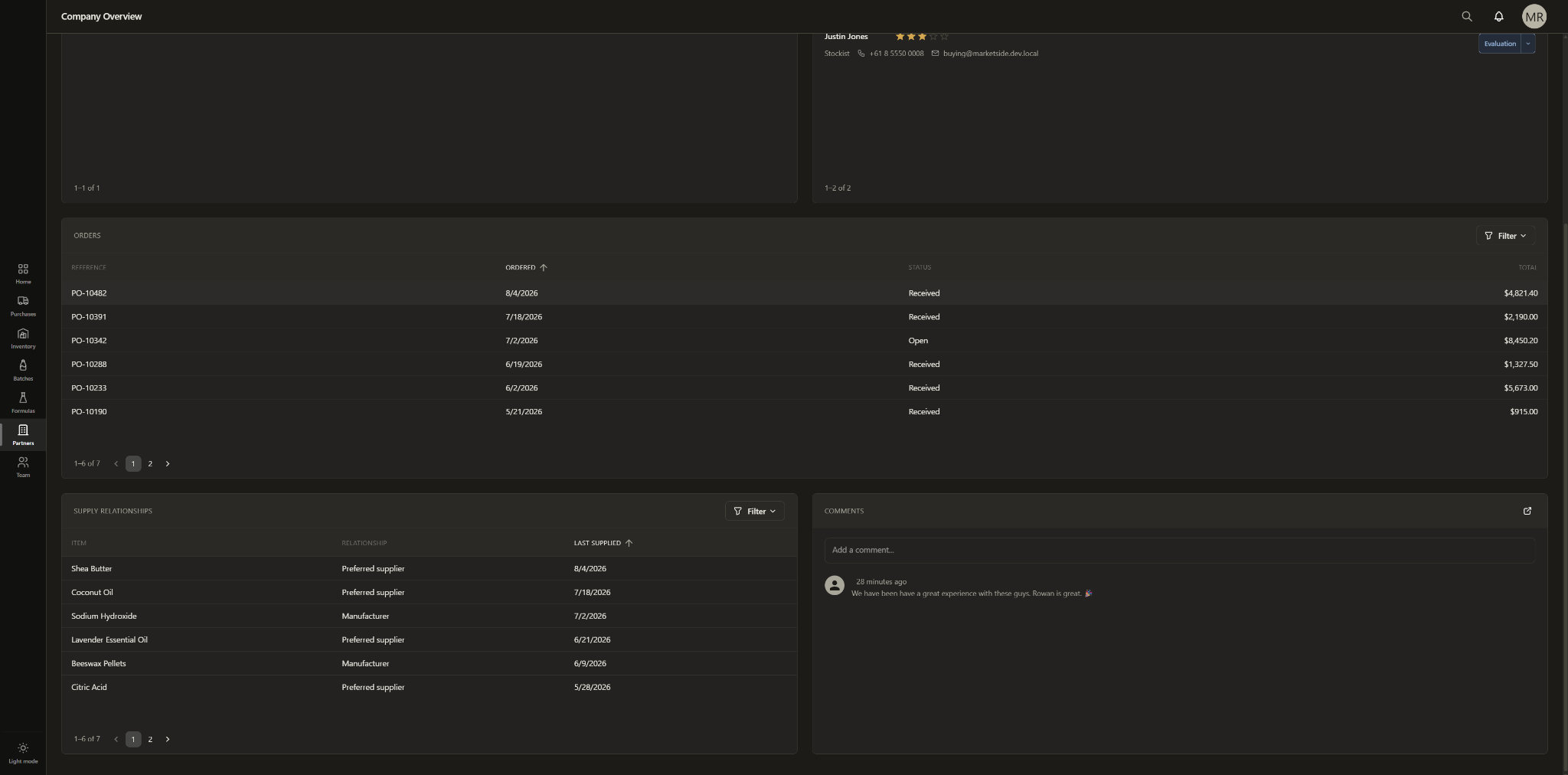
Orders, supply relationships, and comments complete the page below the paired sections. These are the same domains covered in earlier posts, now surfaced in the context of the company they belong to.
Orders shows the purchase order history for this company. Supply relationships show the inventory types we source from them. Comments is a threaded conversation attached to the company record, which can be expanded into a side panel for teams that use it heavily.
Each section pages within its own body. The page does not grow as history accumulates. Reaching an order from six months ago does not change the height of the sections beside it.
What this unlocks
For the first time in the series, the architecture is producing a customer-facing capability rather than laying groundwork for one. A soap maker can open a company profile and see, in one place, everything the application knows about that commercial relationship.
The company and partnership domains were covered in an earlier post. What is new here is that the frontend data layer described in the last two posts is now demonstrably doing its job. Independent domains, each built and tested on their own, compose into a coherent operational view without each section knowing about the others.
What's next
The next post covers bringing recipe development to the frontend: the formulation interface, saponification calculations, and soap property predictions in the hands of a soap maker.
Liked this post? Tap the heart to let us know.
Get early access
Be the first to hear about early access, roadmap updates, and exclusive early adopter pricing.
Join the early access list